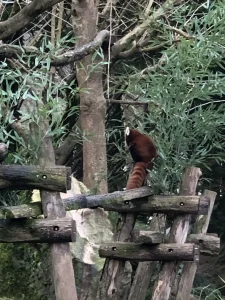
The red panda is one of the zoo's most popular animals, and one of the least understood. Many visitors walk past its enclosure without knowing it is not related to the giant panda. Here is everything to know about this fascinating little red animal.
See the red panda at Beauval
Tickets from €39, booking recommended.
Contents
🦊 The red panda: an animal in its own right
The red panda (Ailurus fulgens) is not a variety of giant panda. It is a completely separate species, with no close link to the black-and-white bear. It belongs to its own family: the Ailuridae.
- Size: like a large cat, 4 to 6 kg, 55 to 65 cm long plus a 45 cm tail
- Fur: bright russet on the back, dark belly and legs, pale facial mask
- Natural habitat: mountain forests from the Himalayas to Yunnan, China
- Diet: bamboo (60 to 95% of its diet), plus fruit, berries and insects
- Lifestyle: nocturnal and crepuscular, it spends much of its time in trees
- IUCN status: endangered (fewer than 10,000 estimated in the wild)
Where to see the red panda at Beauval
The red panda lives in the Heights of China territory, near the giant panda enclosure. Its space has trees, branches and platforms, true to its forest habitat.
The enclosure is often less crowded than the giant pandas' next door, which gives you time to really watch the animal moving through the trees. Remember to look up into the branches: it can be hard to spot when asleep.
A red panda cub born in July 2026
A red panda cub was born on 4 July 2026 in the Heights of China. Its parents are Ines and Browny.
As of 19 September 2026, the ZooParc had announced neither its sex nor its name. The cub mainly stayed sheltered in its den, with its mother.
Red panda cubs usually first leave the nest at around 3 months: it should gradually become visible from autumn 2026. Nothing is guaranteed: it takes a little patience and luck.
When is it active?
The red panda is crepuscular and nocturnal. In the middle of the day, it often sleeps in the trees, curled up in a ball.
- Early morning (9-10am): often still active
- Late afternoon: a second burst of activity before evening
- In cool weather: more active in autumn, winter and spring than in high summer
The mix-up with the giant panda
A little-known fact: the red panda was described and named scientifically before the giant panda. The original "panda" was this one. Only later, when the black-and-white bear was described, was the word "giant" added to tell them apart.
The two species share a few things (the same mountain regions of Asia, a taste for bamboo) but that is where the relationship ends. The giant panda is a bear; the red panda belongs to its own family.
At Beauval, both species can be seen in the Heights of China, in separate enclosures. Full guide to the Beauval giant pandas.
An endangered species
The red panda is listed as endangered on the IUCN Red List. Fewer than 10,000 are estimated to remain in the wild, a number falling because of deforestation and poaching.
Beauval takes part in the European Endangered Species Programme (EEP) for the species. In the field, the Beauval Nature association supports the Red Panda Network in Nepal: anti-poaching work, monitoring and forest restoration.
- Species: Ailurus fulgens
- Family: Ailuridae (a family of its own)
- Estimated wild population: fewer than 10,000
- Main threats: deforestation, habitat fragmentation, poaching
- Conservation programme: EEP
Practical info
| Location | The Heights of China (near the giant pandas) |
| Best time | Early morning (9-10am) or late afternoon |
| Crowds | Fewer people than at the giant pandas |
| Activity | Crepuscular, often asleep during the day |
| IUCN status | Endangered |
| 2026 birth | 4 July (parents Ines and Browny) |
Two mornings in the Heights of China
With a night nearby, you are there at 9am, the best time for both pandas.
To plan your visit: all Beauval's must-see animals | giant pandas guide | suggested itinerary | 10 practical tips | book your tickets