Around 800 species and 24 territories over 46 hectares: ZooParc de Beauval is the most visited zoo in France. Here is the list of animals territory by territory, so you know where to find each one and miss nothing.
Plan your visit
Tickets from €39 online, cheaper than at the gate.
Contents
Beauval in figures
| Species | Around 800 |
| Territories | 24 |
| Area | 46 hectares |
| Only in France | Giant pandas, wombats |
To get a sense of the distance between all these territories: how big is ZooParc de Beauval?
🌟 The ZooParc's stars
The giant pandas
Beauval is the only zoo in France with giant pandas. The twins Huanlili and Yuandudu, born at Beauval on 2 August 2021, live in the Heights of China, until at least January 2027.
For British visitors, they are one of the closest chances to see giant pandas since Edinburgh Zoo's pair returned to China in December 2023. There is no organised queue at their territory. Everything to know: our guide to the giant pandas of Beauval.
The wombats
Beauval is the only zoo in France with wombats: Sandy and Mersey, two common wombats, in Les Terres Rouges. They spend a lot of time in their burrow: come back early in the morning or late in the day.
Everything to know: our guide to the Beauval wombats.
🗺️ Animals territory by territory
The species below are those the ZooParc highlights for each territory. The list is not exhaustive: each territory is home to others. Find them on the ZooParc map.
The Heights of China
- Giant pandas, red pandas
- Golden snub-nosed monkeys, snow leopards, takins
The red pandas had a cub on 4 July 2026: all about the red panda.
Les Terres Rouges (new in 2026)
- Common wombats, red kangaroos, emus
- Parma wallabies and rock wallabies
You walk among the kangaroos, along the path: our visit to Les Terres Rouges.
The Koala Greenhouse
- Koalas, kangaroos, Tasmanian devils, tree kangaroos
- Corals
The Equatorial Dome
- Manatees, giant otters, pygmy hippos
- Douc langurs, Komodo dragons
- Cuvier's and Schneider's dwarf caimans, birds and reptiles
The African Savannah
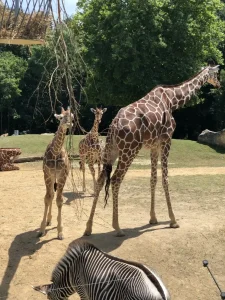
- Giraffes, zebras, white rhinos
- Antelopes, giant tortoises
The Elephant Plains
- African elephants, okapis
- Yellow-backed duikers, mongooses
The Hippopotamus Reserve
- Hippos, red river hogs
- Bongos, nyalas, pelicans
The Land of the Lions
- Lions, African wild dogs, meerkats
- Mole-rats, rock hyraxes
The Cheetah Territory
- Cheetahs
The Big Cat Woodlands
- Sumatran tigers and white tigers, Persian leopards, jaguars, hyenas
- Raccoons, binturongs, small-clawed otters
The Asiatic Plains
- Indian rhinos, Malayan tapirs
- Cranes, Javan langurs, antelopes
The North American Territory
- Brown bears, Arctic wolves
The Great South American Aviary
- Cuban flamingos, ibises, ducks, vultures
- Giant anteaters, howler monkeys
The South American Pampas
- Lowland tapirs, capybaras
The Gorilla Greenhouse
- Western lowland gorillas, patas monkeys, rays
The Orangutan and Chimpanzee Greenhouse
- Chimpanzees, orangutans
- Pygmy marmosets, cotton-top tamarins
The Bird Tropical Greenhouse
- Rhinoceros hornbills, Victoria crowned pigeons, mouse-deer
The Parrot Rotunda
- Hyacinth macaws, sulphur-crested cockatoos, palm cockatoos
- Amazons, keas, lorikeets, great curassows, vulturine guineafowl
The Monkey Pathways
- Diana and De Brazza's monkeys, moustached guenons, Barbary macaques
The Historic Alley
- Humboldt penguins, in the open air
Vivariums and Aquariums
- Alligators, poison dart frogs, chameleons
Bucolia (new in 2026)
- Around 100 animals from old French breeds: Solognot sheep, Berry black donkeys, Poitevine goats, Contres hens
- Shetland ponies, rabbits, ducks
When we visited in August 2026, you could feed the animals: our visit to Bucolia.
2026 births
- Red panda: a cub born on 4 July 2026 (parents Ines and Browny), in the Heights of China
- Okapi: a birth announced in September 2026 (parents Quinta and Mambasa)
- Manatee: a 34 kg female, announced in September 2026, in the Equatorial Dome
- Sloth: Whoopi's baby, announced on 1 October 2026
Young animals are not always visible in their first weeks. Check the ZooParc's announcements on zoobeauval.com before your visit.
The animals in the shows
- Les Maîtres des Airs: free-flying birds, including birds of prey
- L'Odyssée des Lions de Mer: the sea lions' aquatic ballet
Both are included in the ticket, in season (from about late March to mid-November). Times and tips: our guide to the shows.
Tips for watching the animals
- Arrive at 9am: the animals are more active in the morning
- Come back at the end of the day for the wombats and red pandas
- Stay calm near the glass: the animals come closer
- Do not skip the Equatorial Dome, rich and warm when it is cold
- Plan two days if you want to see all 24 territories without rushing
24 territories in one day is tight
With a night nearby, you visit at your own pace over two days.
FAQ
How many species are there at ZooParc de Beauval?
Around 800 species, spread across 24 territories.
Which animals can you only see at Beauval in France?
Giant pandas and wombats: Beauval is the only zoo in France to have them.
Where are the koalas?
In the Koala Greenhouse, not in Les Terres Rouges, where the wombats and red kangaroos live.
Are there dolphins at Beauval?
No. A plan to welcome dolphins was announced in 2025, but it was abandoned on 25 August 2026.
To plan your visit: suggested itinerary | our practical tips | how much time? | ZooParc map | buy tickets
List based on the territories presented on zoobeauval.com, checked on 7 October 2026.